Most forecasts do not have a track record of transparency and accuracy

Exemptions, and the fact that farm income is outside the tax net, ensure that India's tax-GDP ratio stays low.

'The household sector, which is still the largest contributor of financial savings, has been experiencing a decline in the last six years, and it has fallen below 8% of GDP.'

On the present government's 'Make in India' campaign, C Rangarajan, former chairman of the Prime Minister's Economic Advisory Council, says it is important to first ask for whom it is being made.
The government had no option but to cut spending to meet its borrowing targets.

Concerned by GDP slowdown and unrealistic tax targets, the economists urged Finance Minister Nirmala Sitharaman to implement long-term structural steps like land and labour reforms. Warning against any off-Budget financing the economists said the government should prepare a statement of intent for its social, rural and welfare sector expenditure.

India is among 75 countries with which Switzerland's Federal Tax Administration has exchanged information on financial accounts within the framework of global standards on Automatic Exchange of Information.

These self-appointed well-wishers of AMU are basically for the control or police model of university governance. They have no faith whatsoever in the democratic functioning of the universities, observes Faizan Mustafa, former dean, Faculty of Law, and Registrar, Aligarh Muslim University.
'We get an overzealous army of tax inspectors pushing the economy too hard,' says Ajay Shah.
energy is India's binding supply-side constraint for inclusive growth.

The idea is to incorporate global best practices in the Indian context.

US President Barack Obama on Sunday affirmed his commitment to enhancing India's 'voice and vote' in global financial institutions like IMF.

Shares of public sector enterprises have corrected by up to 22 per cent month-to-date until March 19, 2024. Analysts attribute this steep fall to the valuation exuberance seen after a sharp run in these counters last year and suggest investors remain selective regarding the stocks in this space. "The rally in public sector undertaking (PSU) stocks has been stretched and sharp, although it is somewhat justified by improvements seen in earnings, operations, balance sheets, and overall profitability.

Even though the NIA claims that more than 90 per cent of cases charge-sheeted have ended in conviction, the figure is likely misleading. To date, very few cases investigated by the NIA have resulted in a completed trial, points out former CBI joint director Navneet Rajan Wasan.

Opportunity for India to take leadership in economic diplomacy.

The venture is applying to the Reserve Bank of India for approvals.
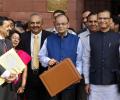
The FRBM report, to be submitted on Tuesday, is likely to have 'excuse clauses', absolving the government of meeting its fiscal commitments under certain conditions such as war or conflict, global economic meltdowns or natural disasters.

This comes as IR posted its worst operating ratio (money spent to earn every Rs 100) in 16 years, at 96.9 in 2016-17.

'So you have welfare programmes, you reach out to the poor, you cut out the middlemen, you cut out the leakages and you try to raise the standard of living.'
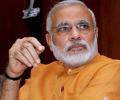
Modi's government plans to support domestic demand

There was no smooth surge in middle class prosperity for foreign businesses to tap into because of the Indian economy was mismanaged, argues Debashis Basu.
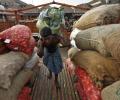
Officials said the government had no option but to cut spending.
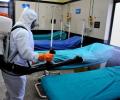
'Most of the testing capacity in India is in the private sector.' 'Whether it is the established RT-PCR test for COVID-19, or it is other innovations in testing that are now coming up, all these are fully within the capabilities of the private sector.' 'Health policy should harness these capabilities,' says Ajay Shah.

The finance minister chided the central bank on Tuesday over its focus on fighting inflation, saying the Reserve Bank of India (RBI) also needed to abide by the government policy to promote economic growth.

In his poll rallies, Modi framed Pitroda's comments in his wider onslaught against the Congress, asserting that they have exposed its hidden agenda and that the party has become so removed from the country's social and family values that it wants to legally rob people of their assets and lifelong savings they want to bequeath to their children.

Hospitals empanelled for Modicare may give preference to poor patients over the middle class for fear of strict government action, says Harsh Roongta.

It shows that states would require a compensation to the tune of at least Rs 1.67 trillion in 2024-25, as none of them would be able to achieve a 14 per cent growth every year.

The agency had received Rs 946.51 crore to manage its affairs in the Budget Estimates for 2023-24, which was later increased to Rs 968.86 crore in the Revised Estimates.

Modi had campaigned with promises of jobs, infrastructure and development.

India's role as a leader of the global south may require it to give up its ambition to serve as a bridge between the warring halves of the international community, points out Mihir S Sharma.

Ajay Banga was on Wednesday appointed the next president of the World Bank, becoming the first-ever Indian-American to head the global financial institution which said it looks forward to working with him at a time when it's tackling the toughest development challenges facing developing countries. "The executive directors of the World Bank today selected Ajay Banga as president of the World Bank for a five-year term beginning June 2, 2023," the bank said in a press statement. In February, President Joe Biden announced that the US would be nominating Banga, 63, to lead the World Bank because he is "well equipped" to lead the global institution at "this critical moment in history."

Coming Wednesday, Finance Minister (FM) Nirmala Sitharaman will present the 2023 Union Budget - the last full Budget ahead of the 2024 Lok Sabha elections. While India exited 2022 as a relatively bright spot in the global economy, the FM will endeavour to present a Budget that insulates India's economy against global headwinds and recession in advanced economies, while sticking to the path of fiscal consolidation. In this, she is being helped by her core team of trusted advisors.
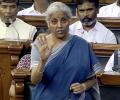
Scheduled commercial banks have written off loans amounting to over Rs 10.09 lakh crore in the last five financial years and the process of recovery of dues from the borrowers continues, Union Finance Minister Nirmala Sitharaman informed the Lok Sabha on Monday.

Raghuram Rajan is said to have informally written to select policymakers and experts, to curb 'unnecessary' speculation over his future at RBI.

Heads of state and big-name billionaires opened the Paris climate summit with a bang on Monday.

'There is no scope for any doubt. This was a scheme designed to enrich the ruling party.'

The current salary paid by the Delhi government amounts to 17 per cent of the total expenditure.

The Centre has constituted a five-member expert committee to study various alternatives available to it to decide on a new capital for Andhra Pradesh.

The most immediate challenge for growth is the disruption of the global economy brought about by the Ukraine war and related sanctions, the Covid shutdowns in China and the rising tide of inflation, points out Nitin Desai.

With the two members quitting, the NSC now has only two members -- Chief Statistician Pravin Srivastava and NITI Aayog CEO Amitabh Kant.
